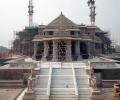
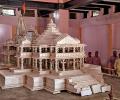
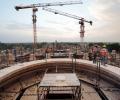
The construction of the three-storeyed Ram temple in Ayodhya will be completed by December this year, temple construction committee chairperson Nripendra Misra said on Thursday. The sprawling temple complex will also have other structures.

January 22, 2024 is not merely a date but marks the advent of a new era, PM Modi declared.
According to trust sources, Union Home Minister Amit Shah, Defence Minister Rajnath Singh, Rashtriya Swayamsevak Sangh chief Mohan Bhagwat , Maharashtra Chief Minister Udhav Thackeray and Bihar CM Nitish Kumar are also on the list of invitees.
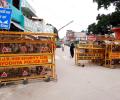
Unlike in the past, the Vishwa Hindu Parishad is not celebrating any "Shaurya Diwas" (Bravery Day) on Tuesday and there are no plans by the Muslim community to observe a "Black Day".

With the general election round the corner, the BJP believes its show of intent for building the temple could consolidate its core supporters.
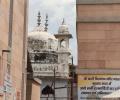
The Supreme Court's 2023 order refusing to stay a scientific survey at the Gyanvapi Mosque complex has sparked claims over several other disputed places of worship across India. This has led to several court cases, including one in Mathura where a survey of the Shahi Idgah Mosque complex was ordered, and another in Ajmer where a claim was made that a Shiva temple existed within the dargah of Sufi saint Moinuddin Chishti. The article also highlights a dispute over the Bhojshala in Madhya Pradesh, which Hindus consider a temple and Muslims consider a mosque. The Supreme Court's order has reignited debates about the Places of Worship (Special Provisions) Act, 1991, which prohibits the change of character of religious places as they existed on August 15, 1947.
The submissions were made during the eighth day hearing in the case before a bench headed by Chief Justice Ranjan Gogoi.
The Uttar Pradesh government has given the allotment letter to the Sunni Waqf board for the land in Dhannipur village in Sohawal tehsil in Ayodhya on the Lucknow highway, about 18 km from the district headquarters, state government spokesperson Shrikant Sharma told reporters on Wednesday.

Earlier, there was a debate if Modi is entitled to adopt the role which usually goes to a "householder".

The Vishwa Hindu Parishad and the Bajrang Dal have announced that they will mark the day as Shaurya Diwas and Vijay Diwas (day of victory) and have asked the people to light earthen lamps as on Diwali.

'Attending roza-iftar with a skull cap is not secularism. People also know that this is drama'

Besides, various representatives of the Shri Ram Janmabhoomi Teerth Kshetra, members of the Rashtriya Swayamsevak Sangh, Vishwa Hindu Parishad and their allies are also aiding in hand-delivering the invitations.
'We have devotion towards Gyanvapi so doing something as per that, it's all right. But why look for a Shivling in every masjid?'

Dhananjaya Y Chandrachud, however, had no qualms about overturning the judgements of father Y V Chandrachud on hot- button issues like adultery and the right to privacy.
The bench will be headed by Chief Justice Ranjan Gogoi and also comprise of Justices S A Bobde, N V Ramana, U U Lalit and D Y Chandrachud.
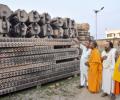
In the late 1990s, the construction cost of the Ram temple, according to unofficial estimates, was pegged at Rs 120 crore. Adjusting for inflation to the current financial year, the edifice would entail an investment of nearly Rs 450 crore, excluding the land cost.

Senior advocate Rajeev Dhavan, representing the Muslim parties in the case, tore up a pictorial map.

Sources in the prominent Muslim body Jamiat Ulama-i-Hind said it was not in favour of filing a review petition and wants the matter to end.

The arguments in the matter were the second longest after the landmark Keshvanand Bharti case in 1973 during which the proceedings for propounding the doctrine of basic structure of the Constitution continued for 68 days.

In what could be a turning point in the Ayodhya dispute, the Archaeological Survey of India has reported to the high court that its excavations found distinctive features of a 10th century temple beneath the Babri Mosque site.
Nothing would please our adversaries if the court verdict sees triumphalism on the part of the majority and sullen anger of the minority, says Colonel Anil A Athale (retd).

The Vishwa Hindu Parishad was on Monday refused permission by the Uttar Pradesh government to organise a yatra from Ayodhya to push for the construction of a Ram Temple at the disputed site, just days after it asked Samajwadi Party chief Mulayam Singh Yadav to work as a bridge between Hindus and Muslims on the issue.
The event will be marked by prayers to Lord Shiva at the Kuber Tila shrine on the Ram Janmabhoomi site, allocated for the temple in a historic Supreme Court verdict last November.
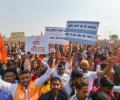
The verdict on the temple-mosque land dispute is expected to be pronounced before Chief Justice of India Ranjan Gogoi retires on November 17.
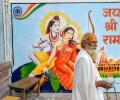
Tired of living under the restive shadow of communalism, Ayodhya residents, be it Vijay Singh or Mohammad Azim, do not want any fresh political trigger for communal disharmony.

Hashim Ansari's son says the long-drawn court battle had left his father disillusioned.
The Act prohibits conversion of any place of worship and provides for the maintenance of the religious character of any place of worship as it existed on August 15, 1947.
'We will not accept this lollypop. They must make clear that where they want to give us the land'
He also said Prime Minister Narendra Modi is expected to take part in an event related to the pran pratishtha on any day during January 20-24.
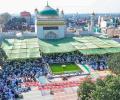
The law prohibits conversion of any place of worship and provides for the maintenance of the religious character of any place of worship as it existed on August 15, 1947.
'This evidence is important to solve the dispute.'
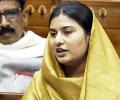
Samajwadi Party leader and Kairana MP Iqra Choudhary has moved the Supreme Court seeking effective implementation of the Places of Worship (Special Provisions) Act, 1991. This move comes amidst several petitions challenging the law's validity, including those filed by the Akhil Bhartiya Sant Samiti and lawyer Ashwini Upadhyay. The Supreme Court, in December 2022, had restrained all courts from examining fresh suits and passing interim orders in pending cases seeking to reclaim religious places. The Act aims to maintain the religious character of places of worship as they existed on August 15, 1947, but the dispute relating to Ram Janmabhoomi-Babri Masjid at Ayodhya was kept out of its purview. The court has listed Choudhary's plea with other pending pleas for February 17.
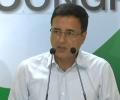
They said it was then prime minister Rajiv Gandhi who on February 1, 1986 got the permission for starting prayers at the disputed site and got the locks opened.

As dusk fell, volunteers lit up nearly six lakh diyas lined up on the Saryu riverbank. 'Representatives of the Guinness Book of World Records witnessed this grand festival. With 5,84,372 earthen lamps, the event made the world record,' a state government statement said.
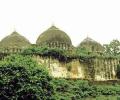
'Babur has been facing gross historical injustice for the last two centuries, when he had no role either in the demolition of any temple or in the construction of the so-called Babri mosque at Ayodhya.'

The court asked the UP govt to get examined the disputed premises by a five-member team of the ASI at its expense.
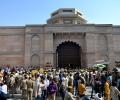
The Supreme Court of India is scheduled to hear a batch of petitions challenging the validity of certain provisions of the Places of Worship (Special Provisions) Act, 1991, which prohibits lawsuits to reclaim a place of worship or change its character from what prevailed on August 15, 1947. The pleas, including one filed by Ashwini Upadhyay, argue that these provisions violate the right to judicial remedy and create an arbitrary cut-off date. The matter will be heard in the backdrop of several ongoing cases related to places of worship, including the Gyanvapi Mosque in Varanasi and the Shahi Idgah Mosque in Mathura. The Muslim side has cited the 1991 law to argue that such suits are not maintainable. The Supreme Court had previously sought the Centre's response to Upadhyay's petition, which alleged that the law creates an "arbitrary and irrational retrospective cut-off date" for maintaining the character of places of worship.

'The verdict must be seen as something more; as a historical balm, a moral restitution and the deliverance of justice to a people wronged,' argues Vivek Gumaste.

Here is a timeline of the second-lengthiest case in the apex court history:
